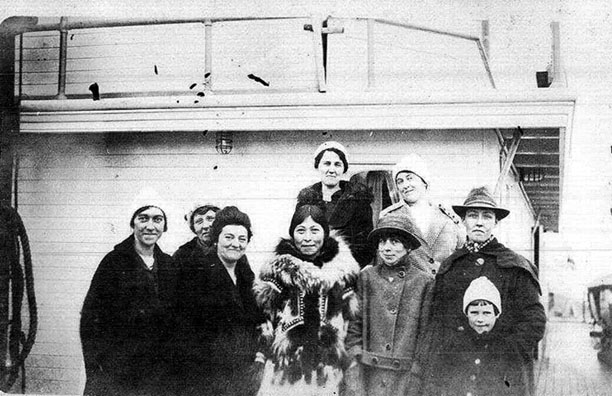
Unaquthlook (center) on the ship headed to the Pan Am Exposition.
A New York climate was much too warm in the summer for Eskimo people accustomed to a cooler weather. They were often dressed in linen garments, but continually asked Concessionaire W.G. Taber to bring them ice. One reporter tells a story of Mr. Taber scolding the Eskimo Natives for removing their parkas, and swimming in the local pool. [9] Later, toward the end of the Pan Am in October, they were becoming cold, and received no instruction to how to use the heaters provided.
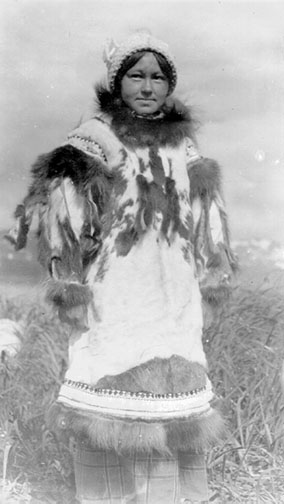
Rosie Midway Spoon as a young girl.
No one knows the details of their journey both to and from the Pan Am except that Maryanne returned home to her husband and was expecting a child. She gave birth to my Grandmother, Rosie Midway Spoon, in May 1902. She returned to her husband, Kayataluk, whose name was translated to spoon or ladle, and was also known as John Spoon. John and Maryanne had two more children Frank and Annie.
The Spoon family continued to live in Nome until the United States Government launched an experiment prior to 1920, to retrain the Inupiat Eskimos of the region to become reindeer herders. [10] The entire village was transported by US Revenue Cutter Ship, along with a herd of reindeer, to Bristol Bay Alaska. This was never a success by any measure, and the family remained fisherman, catching the Kings and Red Salmon of Bristol Bay. John and Maryanne's children, Nanarook, Rosie, Frank and Annie, each married and raised families in the Pilot Point. Government sponsored teachers founded native schools, teaching native students reading and writing in English, health care, and religion. The Inupiat/Eskimo Language was lost about this time, and by the 1940's students were sent outside to boarding schools to continue their high school education.
Nanarook married Sam Supsook, raising 4 children. Sam was expected to become the next chief but he was not encouraged by Kayatuluk. Sam was a successful hunter, shooting a large bear on the first try with an arrow, while waiting in the grass. [11] Nanarook's son, Valentine died recently, and he was the last family member to remain in Pilot Point.
Frank Spoon married Effie Newport, a local village girl, and many of their descendants reside in southeast Alaska and the East Coast of the United States.
Annie Kayali Spoon married Nick Meticgoruk, who was the village photographer, barber, and dentist. They had 10 children, with only two surviving past infancy. Annie's daughter, Mary Pearl Meticgoruk, has been my partner in preserving the family stories and writing the family tree. Much of the family history is preserved in the pictures taken by Nick Meticgoruk and which are now carefully scanned into computer images. Pearl's children live primarily in Anchorage, Alaska. Annie was greatly loved by the family and died of cancer in 1942.
Rosie Spoon married Henry Orock and they had 10 children, including my father, Billy Gilbert Orock. He was the second child with this name as an older child who died in infancy also was called Billy. Henry Orock traveled in a kayak as a young man to join the rest of the village in Bristol Bay. [12] It was on this trip Henry lost his hearing and never learned to speak English because of the hearing loss. Rosie was divorced from Henry, remarried a Romeo Nanooruk, had one more son. Rosie died in August 25, 1965, in Anchorage, Alaska.
My father, Billy, is the oldest surviving respected Elder, and has been the source of Eskimo names and documentation. It was a project for both of us to research this story, as the memories of names and places long forgotten surfaced. It is Unaquthook's story to tell, but it was Billy's memories that held the facts. Billy moved into the modern world serving in World War II, and learning electronics, radio and television repair, and ham radio. At the same time, he continued to fish every year in Bristol Bay, Alaska, and still regards it as his birthright. Two of Rosie's daughters, Martha Orock Lonsdale and Meribeth Orock Hasty, have continued as artisans, using skills taught by Rosie to create beautiful pictures made of fur and skin.
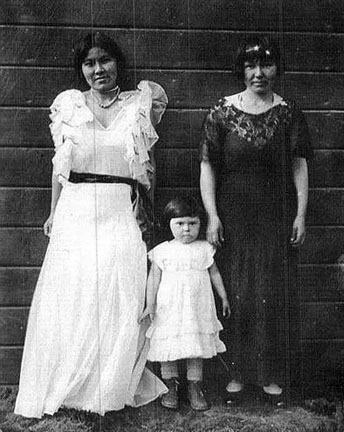
Annie Spoon Meticgoruk, Clara Orock Nieuwendorp, and Rosie Spoon Orock, taken in approximately 1934.
Acknowledgments
Pearl Meticgoruk Reamer, Billy G. Orock, Sr., Clara Orock Nieuwendorp, David Lonsdale, Valentine Supsook, Barbara Seals Nevergold.
Contact Information
Sandra Orock Hall, sandy.orock@verizon.net
Barbara Seals Nevergold, info@uncrownedcommunitybuilders.com
1 Doing the Pan Web site, This Day in 1901. http://panam1901.bfn.org/.
2 Conversation with Mary Pearl Reamer, who was told by her mother that she was named after her Grandmother, Maryanne.
3 Picture from the archives of Nick Meticgoruk.
4 Buffalo Evening News, May 25, 1901. Doing the Pan Web site, This Day in 1901. http://panam1901.bfn.org/.
5 Report of the Medical Department of the Pan American Expostion, Buffalo, 1901. http://panam1901.bfn.org/medical/parkreport.html.
6 The Times, May 12, 1901.
7 Doing the Pan Web site, This Day in 1901. http://panam1901.bfn.org/.
8 Billy G. Orock, Sr.
9 Buffalo Courier, June 27, 1901. Esquimos rebel under the hot weather, decide they will go swimming in the lake, and court the spray of the hose.
10 Alaska Reindeer Herdsmen: A Study of Native Management in Transition, by Dean F. Olson. 1969, Alaska Native Curriculum and Teacher Development, http://www.alaskool.org/frmsetsitemap.htm
11 Billy G. Orock, Sr.
12 Ibid. Henry Orock thought he lost his hearing when he fell into contaminated water on his journey by Kayak from Nome to Port Heiden, Alaska.
13 Buffalo Courier, July 20, 1901. Strange writing used by Esquimaux. Hieroglyphic characters indicate the history of events-peculiar beliefs and customs of a dying people.
14 Family Tree compiled by Mary Pearl Meticgoruk Reamer, and Sandra Orock Hall.
15 Picture of sisters Annie Spoon Meticgoruk and Rosie Spoon Orock, taken by Nick Meticgoruk.